
If you’ve ever watched a child light up as they read a book all by themselves, you’ll know just how magical that moment is. For many little ones, that magic starts with decodable texts — those wonderful little books that match the phonics they’ve been taught and let them actually read the words on the page using their new skills.
In early literacy, we talk a lot about phonics, segmenting, blending, tricky words and all the rest. But what really brings it all together is giving children a chance to apply what they know. That’s where decodable texts come in. They’re not just books — they’re bridges.
What Are Decodable Texts, Anyway?
Decodable texts are specially written stories that only use the sounds (phoneme-grapheme correspondences) that children have already been taught. So if you’ve taught s-a-t-p-i-n, then those are the sounds that will pop up in the first book. As more sounds are taught, the texts become more complex — just like their readers!
They’re structured to give children success. No guessing, no relying on pictures and no skipping words. Just real reading using the skills they’ve learned.
Why Are They So Important?
Here’s why decodable texts are absolute gold in the early stages of reading:
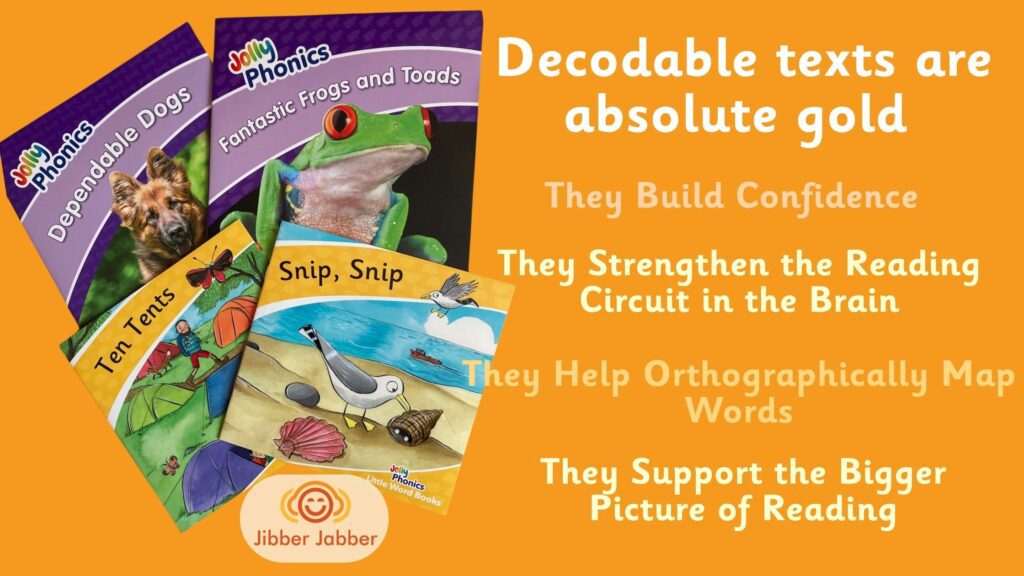
They Build Confidence
Nothing beats the feeling of reading an entire book independently. Even if it’s just “Pat sat. Sam sat.” — that feeling sticks. Children feel proud, and that pride is powerful motivation.
They Strengthen the Reading Circuit in the Brain
Learning to read is not a natural process — it’s something our brains have to build. Decodable texts help strengthen the neural connections in the brain’s reading circuit by giving consistent practice with sound-letter relationships. Each time a child decodes a word successfully, they’re laying the groundwork for fluent, automatic reading. It’s like weightlifting for the brain — but with books!
They Help to Orthographically Map Words
Here’s a big term that’s actually really simple: orthographic mapping is the process of storing words in long-term memory so they can be recognised instantly. To orthographically map a word, children need to connect the sounds in the word (phonemes) with the letters (graphemes). Decodable texts are designed specifically to help this happen — giving kids lots of chances to see, sound out, and eventually remember words. This is how we grow a strong sight word bank — not by memorising words visually, but by understanding how they’re constructed.
They Support the Bigger Picture of Reading
Reading isn’t just word recognition. It’s making meaning. It’s understanding. And while decoding is the first step, decodable texts also support broader literacy skills like:
- 🧩 Comprehension: Once decoding becomes smoother, children can start focusing on what the text actually means.
- 💬 Vocabulary Growth: Even decodable texts can introduce new and useful vocabulary within a child-friendly context.
- ✍️ Writing Links: When children see and decode words, they’re also learning how to spell them — feeding straight into their early writing.
Where It All Comes Together: Scarborough’s Reading Rope
If you’ve not come across Scarborough’s Reading Rope, it’s a brilliant visual model that shows how skilled reading is made up of many different strands, all working together. Imagine a thick rope made by twisting lots of smaller threads — that’s how reading develops over time.
There are two main strands:
🧵 Word Recognition – This includes phonological awareness, decoding, and the automatic recognition of words (what we call fluency). This is the part most of us associate with phonics teaching — it’s where decodable texts shine.
🧵 Language Comprehension – This is everything that helps children make sense of what they’re reading: background knowledge, vocabulary, sentence structure, understanding of verbal reasoning, and more.
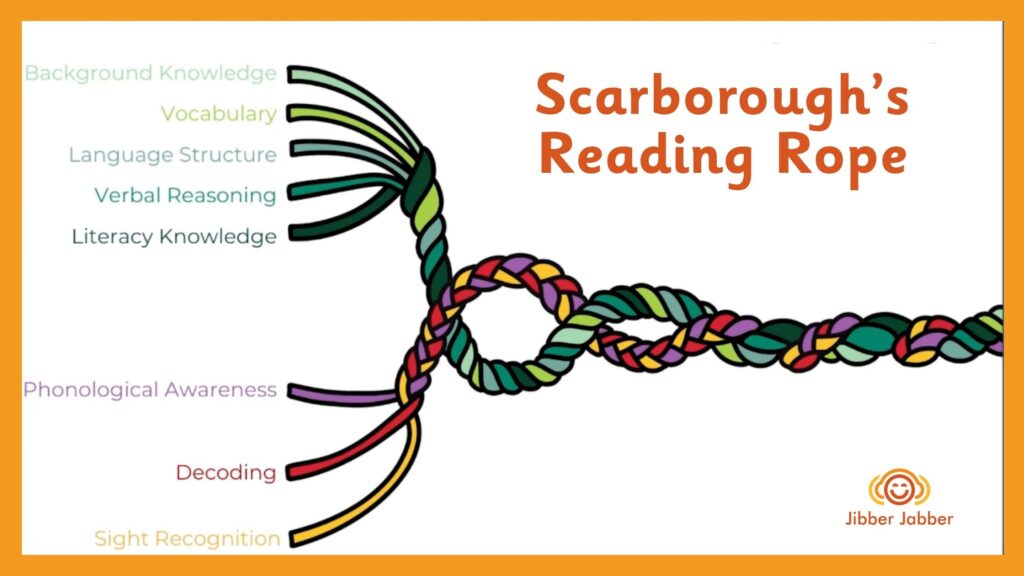
As children grow as readers, these two strands weave together, with each individual skill becoming stronger and more automatic. When word recognition is strong and language comprehension is solid, that’s when reading becomes fluent, meaningful, and enjoyable.
Think of it like this:
A child might be able to decode the sentence “The hen got wet.” — that’s word recognition.
But to fully understand it, they need to know what a hen is, what “got” and “wet” mean, and how a hen might end up getting wet — that’s language comprehension.
Decodable texts support the word recognition side by giving children regular, structured decoding practice with sounds and words they’ve already been taught. But they also start to build comprehension by offering context, sentence structure, and opportunities for discussion.
The stronger each thread in the rope becomes, the stronger the whole rope — and the more confident and capable the reader.
Building Background Knowledge
One thing we sometimes forget when teaching phonics is that knowledge matters. Children need experiences, vocabulary, and understanding of the world to fully make sense of what they read.
Even simple decodable texts can help build this by:
- Introducing new ideas in accessible ways
- Reinforcing language structures
- Offering repeated exposure to certain themes and vocabulary
For example, a decodable book about “A cat on a mat” may seem basic — but it can spark conversations about pets, home life, routines, and more. Use these texts as a launchpad for talk, play, writing, and wider learning.
Match Your Texts to Your Scope and Sequence
One of the most important things to keep in mind is this: use decodable texts that match your scope and sequence.
So what does that mean in real learning terms?
Your scope and sequence is basically your teaching plan — the order in which you introduce sounds (phonemes), letter patterns (graphemes), and tricky words across the year. It’s the structure that guides how phonics is taught, step by step, moving from simple to more complex.
For example, if your class has only learned the sounds s, a, t, p, i, n, then the decodable texts they read should only include those sounds — plus any tricky words they’ve already been explicitly taught (like I or the). That way, they’re using what they know to read successfully, and not being asked to guess or struggle with unfamiliar code.
If you give a child a book with sounds or tricky words they haven’t learned yet — say, ch, sh, or ee — they’ll likely resort to guessing, skipping words, or relying on pictures. And that takes away the whole point of decodable texts!
When the books align with your teaching, you’re creating the perfect conditions for confident, fluent reading. So always check:
- What sounds and tricky words have I taught so far?
- Does this book only use those sounds and words (plus any review ones)?
- Is the text challenging enough to stretch their skills, but not so hard it knocks their confidence?
When the book is just right, children get to apply their phonics knowledge in a meaningful, successful way — and that’s when real progress happens.
If you’re using a structured phonics programme like Jolly Phonics, make sure your decodable texts are aligned. That means introducing sounds and tricky words in the same order, so everything connects clearly for your learners. When the texts match your teaching, you’re building fluency, confidence, and automaticity — all without confusion.
There are loads of decodable books out there, but not all will suit your learners or pace of teaching. Some move too fast, some don’t repeat key sounds enough. Look for ones that are engaging, funny, purposeful — and stick closely to your phonics progression. Those are the books that make reading feel exciting and achievable.
It’s Not About Ditching Picture Books
Just to be clear — decodable texts don’t replace all other books. Picture books are still essential for language development, imagination, and shared reading joy. But in the earliest stages of independent reading, decodable texts are the training wheels that help kids get going. Once they’re off and reading, then they’re ready for a world of books.
Final Thoughts
If you’re working in Nursery or Reception and building your little ones’ reading journey, don’t underestimate the power of a well-matched decodable book. It’s not just another resource — it’s a confidence booster, a phonics practice tool, and a stepping stone into the world of independent reading. So when we hand over a decodable text, we’re not just saying “Here, read this.”
We’re saying, “You can do this — and look how far you’ve come.”
If you found this helpful and want more practical ideas, phonics tips, and freebies straight to your inbox, sign up for the Jibber Jabber Phonics newsletter.
Or if you’d love to bring high-impact phonics training to your school or setting — whether it’s for Nursery, Reception or Key Stage 1 — book a training session with me today. I offer half-day and full-day sessions across Middlesex, London and beyond.
Let’s make phonics fun, purposeful, and powerful for every child — no matter which programme you’re using. 📅 Book a training session with me today – practical, engaging and tailored to your setting.